How to Talk to Your Partner about Switching to Natural Birth Control

So, you’re seeing all of your fav influencers switch to a natural method of birth control and you’re like…. Wait, should I? Or, you’re so tired of your birth control giving you bad symptoms that you’re wondering if today’s the day you’ll finally make the switch to something else.
I get it. Even though using a natural method to avoid or achieve pregnancy has gained more popularity these days, with the rise of Natural Cycles, the Oura Ring, Tempdrop, Apple watch tracking, and more… it sometimes is still hard to take the plunge into a natural method.
Listen, we know our guys want the best for us, but it can feel scary to trust a method that’s natural. It can raise questions for them. It can feel hard to go against the grain. We get it. We’ve been there. If you’re thinking of making the switch, but not sure how to approach the conversation with your partner, we’ve put together a few conversation tips to help guide you as you have this conversation. From one gal, to another.
1) Discuss the alternatives, first:
Oftentimes, men (and even women!) may immediately think - okay, so you don’t love your (insert BC method here). Why can’t you try a different hormonal one?
Toni Weschler, the author of Taking Charge of your Fertility, said it best. “It’s hardly surprising that most people find today’s contraceptive choices far from ideal. Aside from sterilization, our options include such alternatives as a method that infuses the body with unnatural hormones (the pill and other artificial hormone methods), may increase a woman’s risk of breast cancer or osteoporosis (Depo-Provera), involves inserting a matchstick-size silicone tube under the skin of the arm (Implanon), maintains the uterus in a constant state of inflammation, sometimes causing painful periods (IUD), fills the woman’s vagina with a latex dome that leaks gooey spermicide for at least 24 hours after intercourse (the diaphragm), can be uncomfortable and cause cervical anomalies (the cervical cap), is notorious for causing vaginal infections (the sponge), completely covers the woman’s clitoris (the female condom), or places a rubber sheath between the two individuals (the male condom).”
Oral contraceptives, such as the pill, can increase the risk of blood clots, heart attacks, and depression, and can alter our nutrient status. An IUD increases local inflammation and can increase pain during sex. It is also known to have risks of hair loss, increased ovarian cysts, and can increase the risk of infection. Even the "non-hormonal" copper IUD relies on an inflammatory response that can lead to copper toxicity and estrogen dominance. Everything has a chain reaction because our body is totally connected. Overall common risks or side effects of many birth control methods include decreased libido and changes in mood along with many other things that disrupt your normal and all natural you.
2) Share the science behind the method: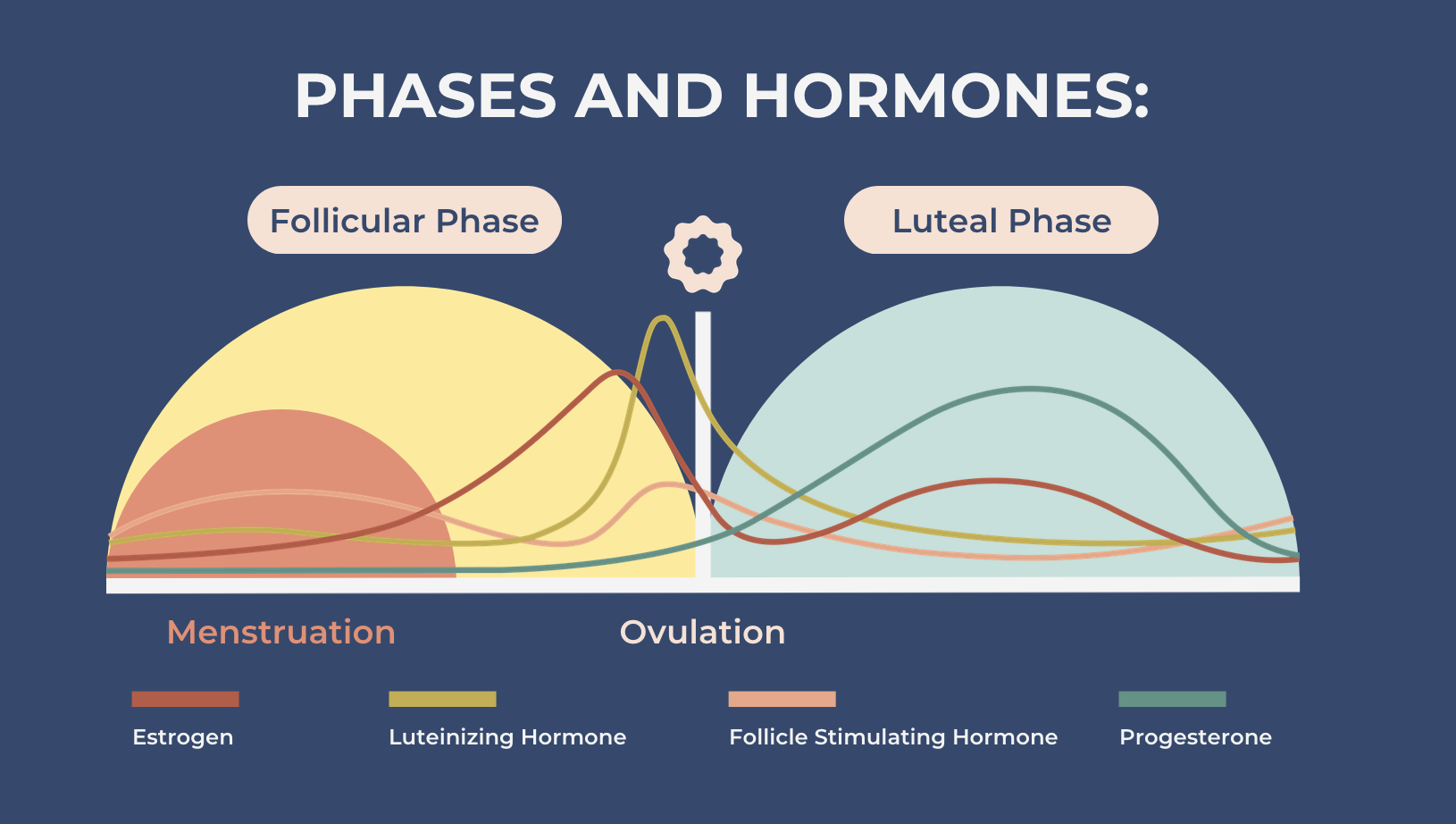
The menstrual cycle is regulated by a complex and beautiful interplay of hormones that work in a coordinated loop. This graphic puts together each phase of our cycle as well as a brief description of what is happening with the key reproductive hormones.
The hormonal cascade of our cycle starts in the brain with the pituitary gland releasing hormones. One key hormone, FSH (follicle-stimulating hormone), encourages the growth and maturation of ovarian follicles, each containing an egg. As these follicles grow, they produce increasing amounts of estrogen, which helps thicken the uterine lining in preparation for a potential pregnancy. Additionally, this rise in estrogen stimulates the cervix to produce fluid called cervical fluid. This is what we know and track!
When estrogen reaches a certain level, it triggers a surge of LH (luteinizing hormone), which prompts ovulation or the release of an egg. After the egg is released, the empty follicle turns into the corpus luteum, which starts producing progesterone. This hormone maintains the thickened uterine lining, making it ready for a fertilized egg to implant. The presence of progesterone halts the production of fertile cervical fluid. This rise in progesterone also increases basal body temperature and keeps it elevated throughout the rest of your cycle, which indicates to us that ovulation has occurred.
If the egg isn’t fertilized, the corpus luteum breaks down, leading to a decrease in progesterone and estrogen levels. This hormonal drop signals the uterus to shed its lining, leading to menstruation and the start of a new cycle. The cycle then repeats as the pituitary gland initiates the release of FSH again, starting the process over.
What the heck does all of that mean???? In a super oversimplified way that does not fully capture everything and does not capture/include all nuances and is not completely accurate (aka why you need to actually learn the method!), basically…
- In the first half of your cycle, as your body prepares for ovulation: estrogen is the star of the show, your cervical fluid gets wet and wetter, and your basal body temperature stays in a low range
- In the second half of your cycle, once ovulation has occurred: progesterone is the star of the show, your cervical fluid dries up, and your basal body temperature rises and stays elevated for the rest of your cycle
Your body is a genius and literally gives you physical signs to help tell you if you’re fertile or not! The sympto-thermal method teaches you to know what the changes in cervical fluid and basal body temperature are telling you about your fertility. You can use these primary indicators to know when you are in your fertile window, and when you aren’t.
3) Highlight how it’s better for your health:
Maybe this feels like an obvious one, but in case it isn’t…
A natural method of birth control means:
- No synthetic hormones
- No turning off a normal, cyclical function (ovulation)
- No living in a constant inflamed state, depleting your nutrients, lowering libido, and increasing risk of depression
Your hormones are not just something that happen ‘to’ you, and only impact your period. Your reproductive hormones impact your brain, your bones, your heart, and yes, your reproductive health.
Choosing a natural method of birth control is about so much more than just avoiding ‘the pill’. Your cycle is a vital marker for your overall health. Just like your blood pressure or heart rate, your cycle is a real-time report card of your health.
- Protecting your hormones and health: Ovulation isn’t just about making a baby; it’s about allowing your body to naturally produce progesterone and estrogen. When it comes to progesterone, think of it as your body’s natural ‘chill pill’ and ‘bone builder’. Progesterone can help reduce anxiety and works with estrogen to strengthen your bones and protect your heart. When you turn off ovulation, you’re doing much more than just avoiding pregnancy. Your hormones (or lack of) are impacting your brain, bones, and heart.
- Lowering Systemic Stress: You avoid synthetic hormones that can lead to chronic inflammation, nutrient depletion, and increased risks of certain cancers.
- Sharing real-time health data: If your cycle is irregular, painful, or missing, your body could be sounding an alarm about your thyroid, your stress levels, or your metabolism. Natural methods allow you to tune in and see what’s going on, instead of just muting it.
Allow yourself to experience your true cycle in its totality. You deserve to know if your body is healthy, to find the root cause if it isn’t, and to give yourself the support you deserve rather than just a temporary mask.
4) …and your sex life
It’s hard to fully express the benefits that the sympo-thermal method brings to your sex life, but we hear it time and time again from our students. It’s one of those things where only once you’ve been practicing the method, you can truly see for yourself the benefits.
When using the sympto-thermal method properly, you can experience the benefits of:
- Real physical connection - Not using a barrier between the two of you during sex
- Shared reproductive responsibility - With the sympto-thermal method, there’s a window of time in your cycle that if you have sex, you can get pregnant. If you are trying to avoid pregnancy, the two of you will abstain in this period of time to avoid the chance of pregnancy. So, it won’t need to be just you feeling like the responsible party for saying ‘yes’ or saying ‘no’ when sex is on or off for the night. It’s the two of you, on the same page about your goals
- Creating a rhythm in your sex life - We aren’t meant to always be ‘on’. So, having a natural period of time built into your cycle when you abstain and when you have sex helps keep your sex life exciting
5) …and your long-term goals
One of the best parts of this method is that it shifts and changes as you do. What that means is, you can use this method to avoid pregnancy by having sex on days outside of your fertile window. Well…when you are trying to get pregnant, you just have to switch the days that you’re having sex to work towards that goal! Rather than getting on the pill, getting off and possibly going through a transitional period of your hormones rebalancing to get pregnant, then getting back on something, and repeating this cycle, the sympto-thermal method is one method that seamlessly flows throughout the different phases of your life.
One of the other reasons we love this method is because in our course, we teach you how to utilize your charts to learn more about your reproductive health. For example, consistently low temperatures (we share what ‘low’ means in our class!) can sometimes be an indicator of a thyroid issue. So, if you were to see that in your chart, you might be more motivated to go to a provider and get lab work done to see what’s going on. Also, a short luteal phase can lead to miscarriage. So, knowing you have a short luteal phase before you’re trying to get pregnant means that you can work with a provider to optimize your progesterone levels and lengthen that phase.
The gist? Yes, this method is harder to learn than taking a pill each day. Yes, this method might require some intentional conversations to get aligned on goals with your partner. But, when you think about the fact that you could be cycling for the next 1-2 decades, we think it’s worth spending the time now to learn it!
SUBSCRIBE FOR THE WEEKLY TEA
Want to know what it's like to be in Melanie and Michelle's group text?? Join our newsletter!! Think of this as a weekly hot tea sesh with your health-obsessed BFFs. We're going to discuss natural fertility, non-toxic swaps we're obsessed with, recipes that keep our hormones happy, and more. We'll also share random life updates, for funsies.
You don't want to get FOMO, do you?! Join our newsletter! We can't wait for you to be part of our community xoxo!
P.S - We hate SPAM (duh?). We will never sell your information, for any reason.